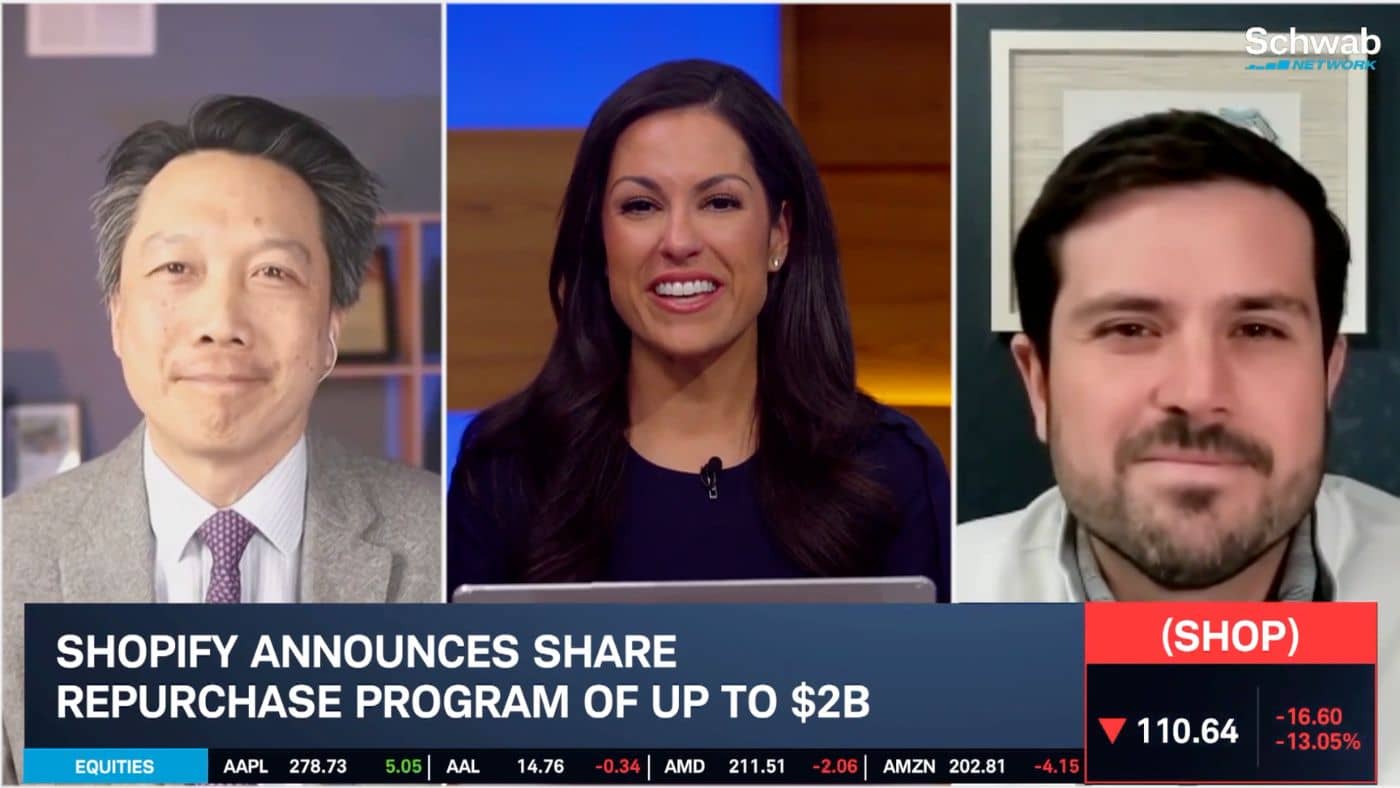
Andy Wang joined Trading 360 with Marley Kayden today to discuss Shopify’s fourth-quarter earnings and the market’s negative reaction despite strong operating performance.
Shopify (SHOP) shares fell sharply after results failed to sustain an after-hours rally. While the price action reflected broader pressure on growth and software stocks, the company’s fundamentals tell a different story—one of durable growth, strong cash generation, and strategic positioning.
Below are the key points Andy covered on air.
The Consumer Bifurcation Story
At first glance, Shopify’s results seem at odds with recent retail data. December retail sales came in flat, reinforcing the narrative of a weakening consumer. Yet Shopify posted 31% revenue growth and 29% GMV growth.
The explanation lies in who is still spending.
Shopify’s merchant base skews heavily toward discretionary categories like apparel, health and beauty, and home goods, segments driven more by higher-income households. While stress is rising among lower-income consumers, higher earners remain resilient. The top 10% of U.S. households now account for nearly half of all consumer spending.
Rising credit card delinquencies, particularly loans 90 days or more past due, highlight pressure on the lower end of the market. But Shopify’s ecosystem is aligned with the most financially secure consumers.
Andy framed this as a structural advantage:
Shopify is positioned where spending resilience lives.
The risk, however, is tied to the wealth effect. If equity markets or home values correct meaningfully, discretionary spending from affluent households could retrench quickly. For now, though, that cohort remains a tailwind, not a headwind.
The $2 Billion Buyback Sends a Message
One of the clearest signals from the quarter wasn’t operational. It was capital allocation.
Shopify announced a new $2 billion share repurchase program, an unusual move for a company still growing above 30%.
The context matters:
- $2 billion in annual free cash flow
- 17% free cash flow margin
- Ten consecutive quarters of double-digit FCF margins
- Debt-free balance sheet
For a growth company, buybacks are intentional. They signal management believes the stock is undervalued relative to future growth.
Andy summarized it simply:
When a company like this buys back stock, they’re saying their best investment opportunity is themselves.
Following the roughly 10% selloff post-earnings, the repurchase program becomes even more accretive, allowing Shopify to retire shares at more attractive valuations.
Bottom Line
While the market focused on guidance nuances and broader software sentiment, the core story remains intact.
- Growth remains strong.
- Cash flow is scaling.
- Management is signaling confidence.
Short-term volatility may persist, but the underlying fundamentals Andy highlighted on Trading 360 suggest Shopify is a growth story worth watching.
Andy Wang is a financial advisor at Runnymede Capital Management. Media appearances are for informational purposes only and should not be considered investment advice.