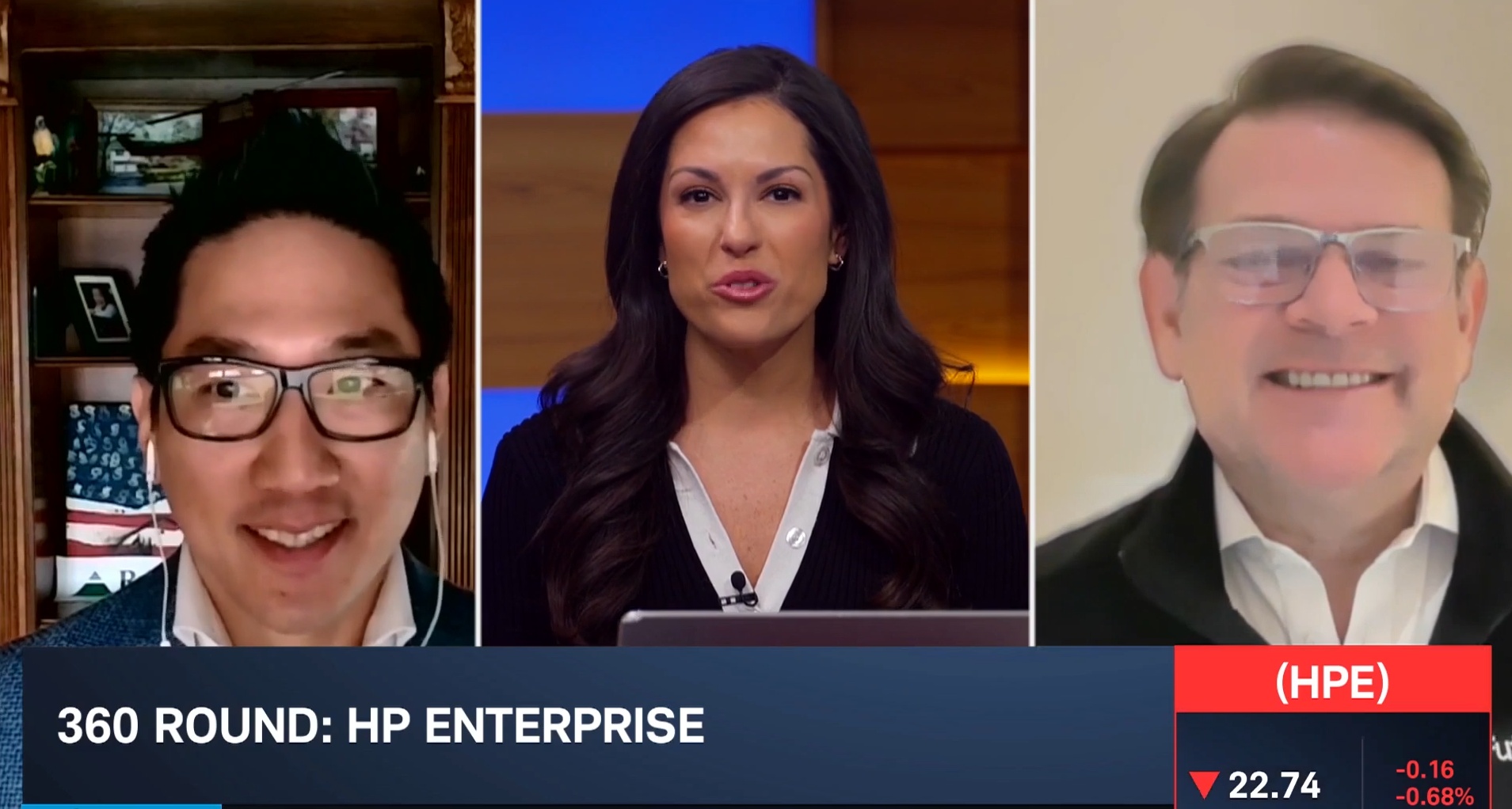
In a recent appearance on Schwab Network's the Trading 360 with Marley Kayden, Chris Wang provided expert insights on HPE's 4Q earnings.
Executive Summary
HPE is currently in a major transition phase, aggressively pivoting towards high-margin Networking (via the Juniper Networks acquisition) and Hybrid Cloud, while managing a “lumpy” but growing AI infrastructure business. While revenue slightly missed expectations due to timing issues, profitability and free cash flow were standout performers, leading management to raise their FY26 outlook.
Key Positives (The “Green Flags”)
-
Record Profitability & Margins:
-
Non-GAAP operating margin reached a record 12.2%.
-
Networking is the star performer with a 23% operating margin.
-
Free Cash Flow (FCF) for the quarter was $1.9 billion, significantly exceeding expectations.
-
-
Successful Juniper Integration:
-
The acquisition is already bearing fruit. Networking revenue increased 150% year-over-year (YoY) with Juniper contributing.
-
Cost synergies are appearing faster than anticipated, contributing to the decision to raise FY26 guidance; possible $1 billion in annualized cost savings by 2028.
-
-
AI Momentum:
-
HPE secured $1.9 billion in AI system orders in Q4.
-
Cumulative AI orders since Q1 FY23 have reached $13.4 billion.
-
Note: The company highlighted their liquid-cooled Cray GX platform, essential for high-density AI workloads.
-
-
Guidance Raise:
-
Management raised the FY26 Non-GAAP EPS outlook to $2.25 – $2.45.
-
They also raised the midpoint of the Free Cash Flow guidance to $1.7B – $2.0B.
-
-
Deleveraging Plan:
-
HPE is selling its remaining stake in H3C (China) for $1.4 billion, with proceeds earmarked to pay down debt and reduce leverage to roughly 2x by FY27.
-
Key Negatives (The “Red Flags”)
-
Revenue Miss & Timing Issues:
-
Q4 Revenue of $9.7 billion came in below the low end of the outlook.
-
This was caused by the “pushout” of AI shipments (deals are signed, but delivery/revenue recognition is delayed).
-
- Weak 1Q guidance:
- 1Q guidance is for a further revenue deceleration and 5-10% below street expectations
- This could be conservative but also shows that AI revenues are pushed out further to the 2nd half of 2026.
-
Weakness in Traditional Segments:
-
Server Revenue: Declined 5% YoY.
-
Hybrid Cloud Revenue: Declined 13% YoY.
-
The company is intentionally exiting low-margin non-IP businesses, which hurts top-line revenue numbers in the short term.
-
-
Rising Component Costs:
-
Management explicitly warned of rising DRAM and NAND (memory) costs in 2026.
-
While they plan to pass these costs to customers, this creates pricing pressure.
-
-
“Lumpy” AI Business:
-
Large sovereign AI deals have long lead times, causing uneven revenue recognition (volatility) from quarter to quarter.
-
-
GAAP Losses:
-
The company posted a GAAP loss of $0.04 per share, largely driven by the heavy acquisition costs and amortization related to Juniper.
-