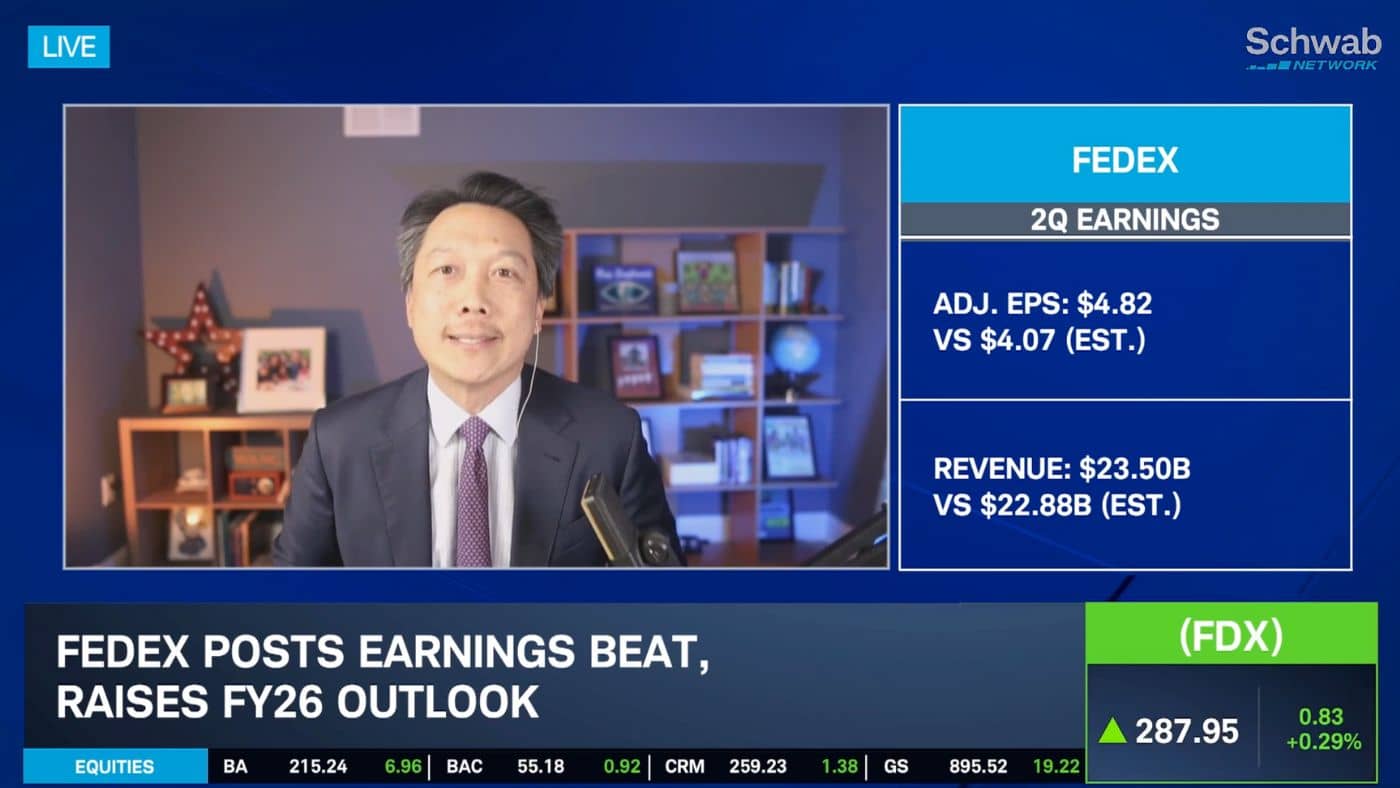
Andy Wang, Managing Partner at Runnymede Capital Management, joined The Watch List with host Nicole Petallides to discuss FedEx Corporation’s latest earnings report alongside Dom Ceci. The conversation focused on why the quarter represented what Andy described as a “high-quality beat,” even as the stock faced short-term pressure following the release.
A Beat Driven by Operations, Not Accounting
FedEx reported earnings per share of $4.82 versus consensus expectations of approximately $4.12. While headline results exceeded estimates, Andy emphasized that the quality of the earnings mattered more than the magnitude of the beat.
In particular, FedEx Express delivered operating income and margin performance that exceeded expectations, supported by both volume growth and pricing improvements. According to management commentary, approximately 66% of FedEx’s total revenue now comes from business-to-business (B2B) shipments, with a significant portion of recent growth driven by higher-quality commercial demand.
This mix shift has meaningful implications for operating leverage. During the quarter, roughly 7% revenue growth translated into approximately 17% earnings growth—reflecting improved efficiency and cost discipline rather than one-time items.
Results Despite Trade and Cost Headwinds
Management also cited approximately $1 billion in trade-related headwinds tied to tariffs, slower global commerce, and regulatory changes affecting international shipments. Despite these pressures, FedEx continued to expand margins at FedEx Express, marking another consecutive quarter of improvement.
Andy noted that delivering margin expansion in this environment suggests the company’s multi-year cost and network initiatives are beginning to show tangible results.
Market Reaction: Short-Term Noise Versus Execution
Despite the earnings beat, FedEx shares traded lower following the announcement. During the segment, Andy and Dom discussed how management highlighted roughly $600 million in anticipated second-half headwinds, including costs related to grounded cargo aircraft, higher incentive compensation, and continued softness in the freight market.
While these factors contributed to near-term uncertainty, management raised the midpoint of full-year guidance, suggesting confidence in underlying execution. The market reaction appeared consistent with broader earnings-season dynamics, where misses have been heavily penalized and beats have often been met with muted responses.
A Broader Transformation Underway
Beyond the quarter, Andy highlighted FedEx’s ongoing transformation across three areas:
- Network transformation, aimed at improving domestic and international efficiency
- Organizational transformation, including the “One FedEx” operating model
- Digital transformation, leveraging data, automation, and artificial intelligence
FedEx has removed several billion dollars in costs over recent years and continues to rationalize its network footprint. Management has stated that these efforts are designed to position the business for improved profitability when shipping volumes normalize.
Express Strength and Freight Optionality
FedEx Express remains the primary driver of current performance, posting multiple consecutive quarters of margin expansion and growth in U.S. domestic package volumes. FedEx Freight, while still experiencing demand softness, has seen pricing trends improve and remains a potential source of longer-term value, particularly as the company prepares for a planned separation of the Freight business.
Perspective, Not a Prediction
As discussed on The Watch List, FedEx’s quarter highlighted operational progress during a challenging macroeconomic backdrop. While short-term market reactions can be volatile, the discussion centered on business fundamentals, competitive positioning, and execution rather than near-term stock price movements.
Watch the segment here: https://schwabnetwork.com/video/fedex-fdx-earnings-breakdown-tariff-costs-but-high-quality-beat