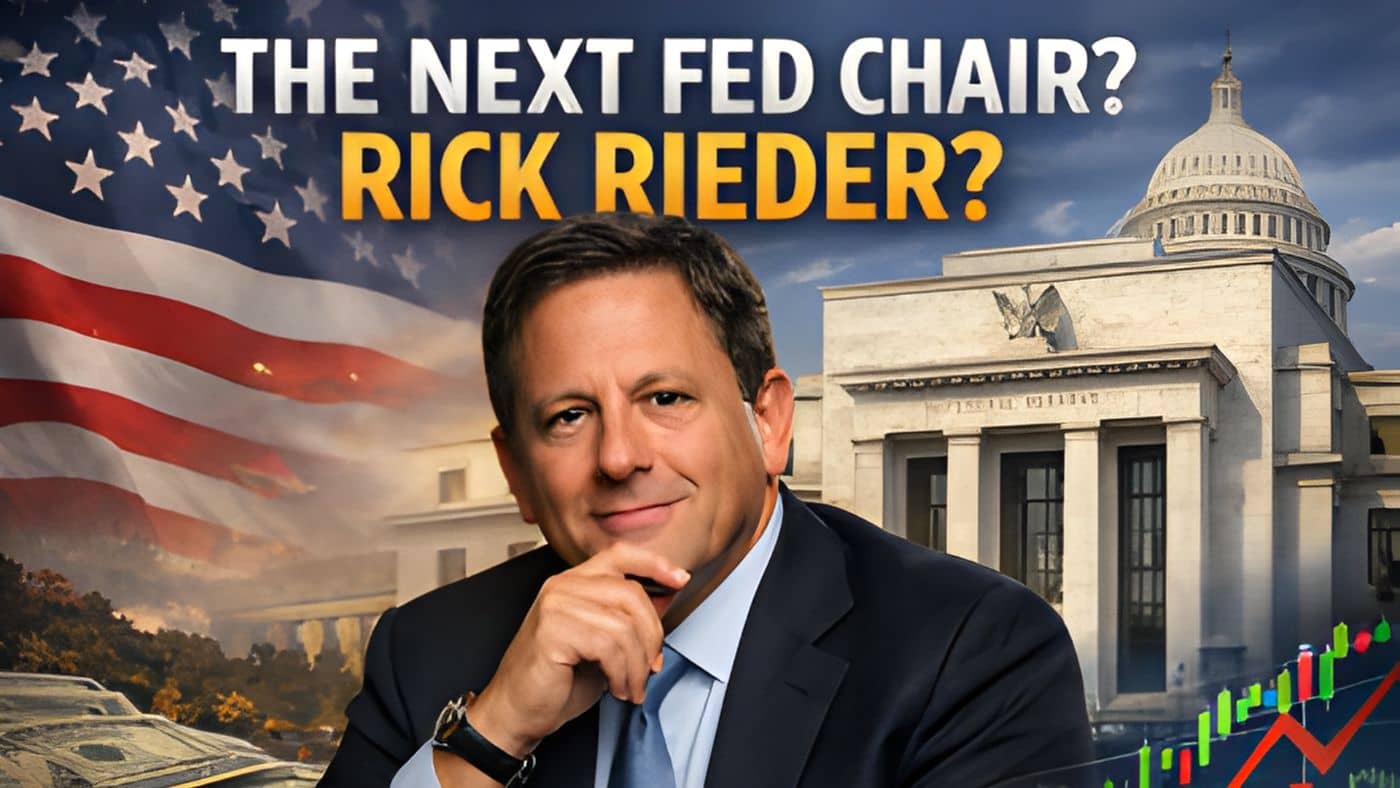
Fed Chairman Jerome Powell’s term is set to expire on May 15th and expectations are that President Trump will announce the next Fed Chair sooner than later.
The race to succeed Jerome Powell as Chair of the Federal Reserve has taken a dramatic turn in the last few weeks. Rick Rieder, BlackRock’s Chief Investment Officer of Global Fixed Income, has emerged as a top-tier contender, fueled by public praise from President Trump and shifting odds in prediction markets.
While Rieder is an unconventional “outsider” compared to academic predecessors, his potential nomination signals a potential seismic shift toward a market-centric, pragmatic Fed.
The Rise of the “Market Master”
For most of 2025, the shortlist for the Fed Chair was dominated by familiar names like Kevin Warsh and Christopher Waller. Just two weeks ago, Rieder’s odds on platforms like Polymarket were just 3%; however in recent days, he has jumped to the frontrunner with 47% odds as January 27th. Kevin Warsh, who is more of an inflation hawk, has fallen to a distant second with 28% odds.
President Trump’s description of Rieder as “very impressive” and White House advisor Kevin Hassett calling him “the best bond guy” have solidified his standing. Unlike former chairs who held PhDs in Economics, Rieder brings decades of experience managing over $2 trillion in assets—a background that appeals to an administration looking to disrupt “technocratic” norms at the central bank.
Policy Implications: Innovation over Dogma
A Rieder-led Fed would likely move away from rigid academic models toward a more “real-time” data approach. Based on his recent commentary, three key policy shifts are likely:
- Aggressive Rate Normalization: Rieder has suggested the federal funds rate (currently 3.5%–3.75%) should be closer to 3%. He argues that the “inflation storm has passed” and that the Fed must pivot to prevent labor market decay.
- Targeting Mortgage Rates: In a departure from standard Fed practice, Rieder has advocated for using the Fed's tools to specifically lower mortgage rates into the mid-5% range to stimulate housing velocity.
- Balance Sheet Creativity: He has hinted at using Yield Curve Control (YCC)—strategically purchasing Treasuries to manage long-term yields—rather than relying solely on the overnight lending rate.
Impact on the 2026 Stock Market
Markets generally hate uncertainty, but Rieder’s deep credibility with Wall Street could provide a “stabilizing shock.”
- The “Rieder Rally” in Housing and Financials
If Rieder moves to explicitly target lower mortgage rates, the housing sector (builders, lenders, and real estate platforms) could see a massive boost in 2026. Lower rates would “unlock” millions of homeowners currently trapped by low-interest mortgages, increasing economic velocity.
- Equity Dispersion
In his 2026 outlook, Rieder noted that the “casino” era of easy gains is over. He predicts a market defined by dispersion, where high-quality companies with durable cash flows and AI-driven productivity gains outperform, while zombie companies struggle with a “higher-for-longer” cost of capital compared to the zero-rate era.
- Cryptocurrency Integration
Rieder has historically been a Bitcoin optimist, once stating it could “replace gold.” A Fed Chair with an open-minded view of digital assets could accelerate the regulatory clarity markets have craved, potentially making 2026 a breakout year for institutional crypto adoption.
If nominated and confirmed by May 2026, Rick Rieder would represent the most significant shift in Federal Reserve culture in forty years—replacing the “Ivory Tower” with the “Trading Floor.”

Feature image from ChatGPT.