Heading into 2026, the Wall Street consensus is remarkably unified and optimistic. After a multi-year run that has defied skeptics, the bulls are once again leading the charge, though a small chorus of cautious voices is beginning to flag the risks of a “valuation reset.”
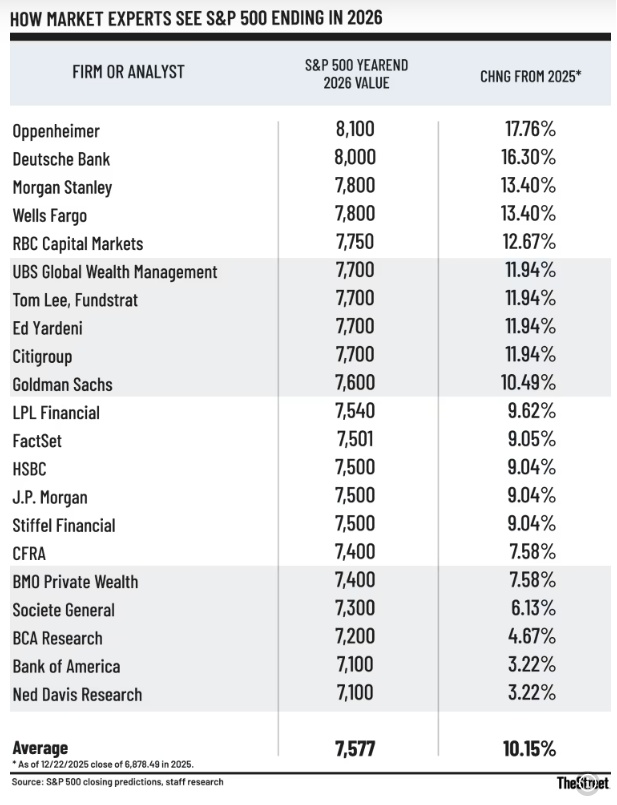
The average year-end 2026 target for the S&P 500 currently sits near 7,577, implying roughly 10% upside from current levels. This is down slightly from a year ago when strategists saw 14.5% upside.
The Biggest Bull: Oppenheimer Sets the Pace
Leading the charge is Oppenheimer’s John Stoltzfus, who holds the most aggressive target on the Street at 8,100. This is his second straight year as being the Wall Street's biggest bull.
His thesis rests on the “persistent resilience” of the U.S. economy and a projected 12% growth in corporate earnings. Stoltzfus argues that even with a “lofty” P/E multiple of 26.5x, the market can continue to climb as long as the Federal Reserve continues its “down payment” on rate cuts and innovation continues to drive productivity.
Similarly, Morgan Stanley and JPMorgan have outlined bull-case scenarios that could see the index reach as high as 8,200 to 9,000, provided that tariff-related headwinds ease and the AI “supercycle” continues to deliver double-digit earnings growth.
The Cautious Chorus: Ned Davis and Bank of America
While the bears are in hibernation, a more measured tone is emerging from firms like Ned Davis Research (NDR) and Bank of America.
Ed Clissold at Ned Davis Research has issued a target of 7,100, suggesting only modest gains for the year. His primary concerns include “unstable” economic relationships, high valuations, and the risk that the market has already priced in all the “good news” regarding rate cuts. NDR warns that the current Shiller P/E ratio is approaching levels last seen during the 1929 and 2000 bubbles, leaving little room for error if earnings growth slows.
Bank of America’s Savita Subramanian also sees a “lackluster” or “muted” year ahead, with a price target of 7,100. While BofA expects healthy 14% EPS growth, they anticipate only 4-5% in actual S&P price appreciation. Subramanian’s team is closely watching for a transition from a “consumption-driven” bull market to a “capex-driven” one, noting that sticky inflation and “circular financing” in the AI sector could spark bouts of volatility and high rotation.

What do you think will happen in 2026? Are you a bull or a bear for the New Year?
Feature image created by Gemini AI