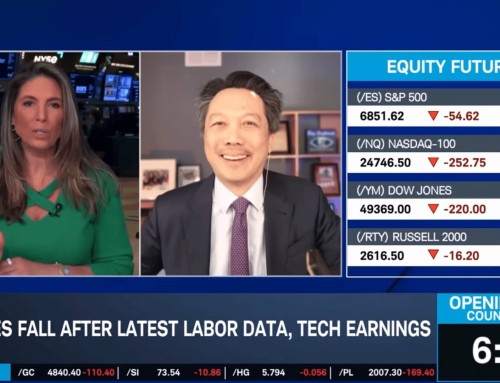
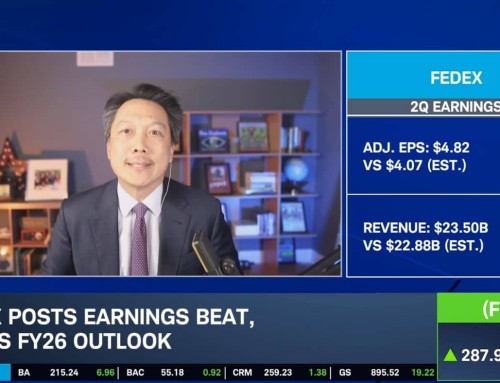
Andy Wang, Managing Partner at Runnymede Capital Management, joined host Marley Kayden and Adam Lampe on Schwab’s Trading 360 to break down FedEx’s (FDX) latest earnings and what they signal about the U.S. economy.
FedEx reported a 24-cent EPS beat with revenues of $22.24 billion versus $21.66 billion expected. While headlines often focus on top-line numbers, Andy emphasized that margins were the true highlight. FedEx Express margins jumped to 6.1% from the expected 5.5%, driving a 17% year-over-year EBIT increase—even in the face of a projected $1 billion trade headwind.
This performance reflects the ongoing transformation of FedEx, including the integration of its U.S. Ground and Express networks (Network 2.0) and efficiency initiatives under DRIVE, targeting $1 billion in cost savings for Fiscal 2026. As Andy noted, “Even with a billion-dollar storm on the horizon, FedEx is steering profitability higher.”
Domestic shipping volumes rose 6% YoY, aided by wins from UPS’s struggles and new Amazon package volumes coming online later this year. Beyond packages, FedEx is leveraging its unmatched logistics data—17 million packages and nearly 2 petabytes of data daily—to fuel AI-driven optimization, predictive shipping, and new supply chain services. As CEO Raj Subramaniam says, this “data advantage cannot be replicated by any competitor.”
Still, Andy cautioned investors to watch global trade weakness. The removal of duty-free “de minimis” exemptions and softer China-to-U.S. volumes are expected to hit FedEx for roughly $1 billion this year, keeping full-year EPS guidance flat despite revenue growth.
Looking ahead, the planned FedEx Freight spin-off in June 2026 could unlock hidden value, sharpen focus on core growth, and potentially enhance capital returns—though near-term execution risks remain.
Key Takeaways:
-
Margins defy trade headwinds: FedEx Express margins at 6.1% vs 5.5% expected.
-
Volume power: 17M packages daily, moving nearly $2T in goods annually.
-
Market share shift: Domestic volumes +6% YoY, capturing business from UPS.
-
Cost savings & efficiency: $1B targeted via Network 2.0 and DRIVE initiatives.
-
Data advantage: 2 petabytes daily supporting AI-driven logistics insights.
-
Global trade risks: Up to $1B headwind from tariffs, softer exports, and lost de minimis shipments.
Andy concluded that while trade uncertainties persist, FedEx’s operational execution, data leadership, and margin discipline position it well to capitalize when global trade rebounds.