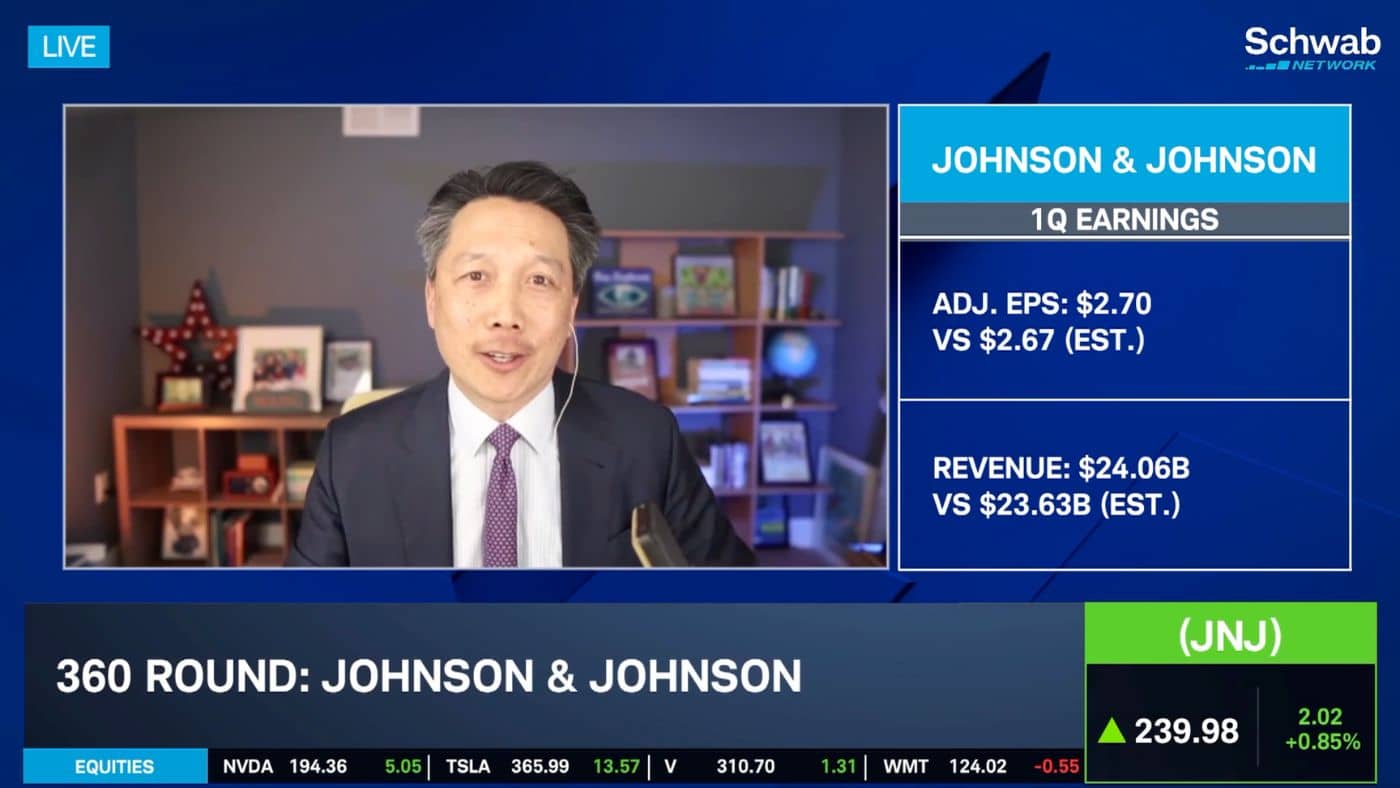
On a recent appearance on Schwab Network’s Trading360, Runnymede's Andy Wang joined Arthur Wong of Healthcare at S&P Global and host Marley Kayden to break down a key themes from Johnson & Johnson (JNJ) earnings.
Andy’s core takeaway: J&J’s strength comes from three areas: its immunology transition, accelerating oncology engine, and a deep product portfolio.
1. The Stelara Transition: Managing the Patent Cliff
A headline number from the quarter was hard to ignore: Stelara sales fell about 60% following loss of exclusivity. But Andy emphasized that the more important story is what happened next.
Rather than losing patients to outside competitors and biosimilars, J&J is actively migrating patients into its own next-generation therapies. That includes:
- Tremfya, which beat expectations by roughly $400 million
- A newly approved oral psoriasis treatment, Icotyde
Andy framed this as a defining characteristic of strong pharmaceutical execution:
This is what managing a patent cliff looks like. You cannibalize yourself before competitors do.
He also pointed out that this marks the fifth consecutive quarterly earnings beat, reinforcing that this is not a one-time adjustment but a consistent execution pattern.
Biosimilar (in simple terms)
A biosimilar is a highly similar version of a biologic drug that has lost exclusivity. Unlike traditional generics, biologics are made from living cells, so biosimilars require more complex testing to confirm they match the original in safety and efficacy.
The key difference is price. Biosimilars introduce competition that helps lower costs while maintaining comparable clinical outcomes.
2. Darzalex and CARVYKTI: Oncology Becomes the Growth Engine
If immunology defined J&J’s past, Andy argued that oncology is defining its future.
The standout driver is Darzalex, which generated about $4 billion in revenue versus $3.4 billion expected, a significant beat from a single therapy. At its current trajectory, Andy noted it could eventually surpass Stelara as J&J’s top product.
At the same time, momentum continues to build in cell therapy:
- CARVYKTI grew more than 60% year-over-year
- Growth was supported by expanded FDA approvals and broader clinical use
Andy highlighted the structural shift underway:
Immunology used to drive the business. Now oncology is the engine—and increasingly, the future.
CARVYKTI (CAR-T therapy explained)
CARVYKTI is a CAR-T cell therapy. It works by collecting a patient’s own immune cells, genetically engineering them to recognize cancer, and reinfusing them to attack multiple myeloma.
In simpler terms, it is highly personalized medicine. Your own immune system is reprogrammed to fight cancer more effectively.
In clinical trials, CAR-T therapies like CARVYKTI have shown extremely high response rates, which is why they are viewed as one of the most promising areas in oncology.
3. Portfolio Depth and Diversification: The Structural Advantage
A final pillar of Andy’s analysis was J&J’s portfolio breadth, which he described as a key competitive moat.
Johnson & Johnson now has more than 28 products generating over $1 billion each, spanning multiple therapeutic areas.
That diversification matters in practice:
- Even with Stelara down sharply, total revenue can still grow near ~10%
- The company is not dependent on one or two blockbuster drugs
- It has flexibility to sustain R&D investment through cycles
Andy emphasized that this structure gives J&J something many peers lack: resilience through transition.
It allows the company to absorb major product declines while still funding innovation and pursuing higher-risk opportunities in its pipeline.
Closing Thought
Across the discussion on Trading360, Andy’s message was consistent: J&J’s story is not about avoiding disruption but absorbing it.
Through immunology transitions, oncology expansion, and deep portfolio diversification, the company is demonstrating how a pharmaceutical giant can continue growing even while its legacy products decline.
For investors, the takeaway is less about any single drug and more about the system J&J has built to evolve through it.