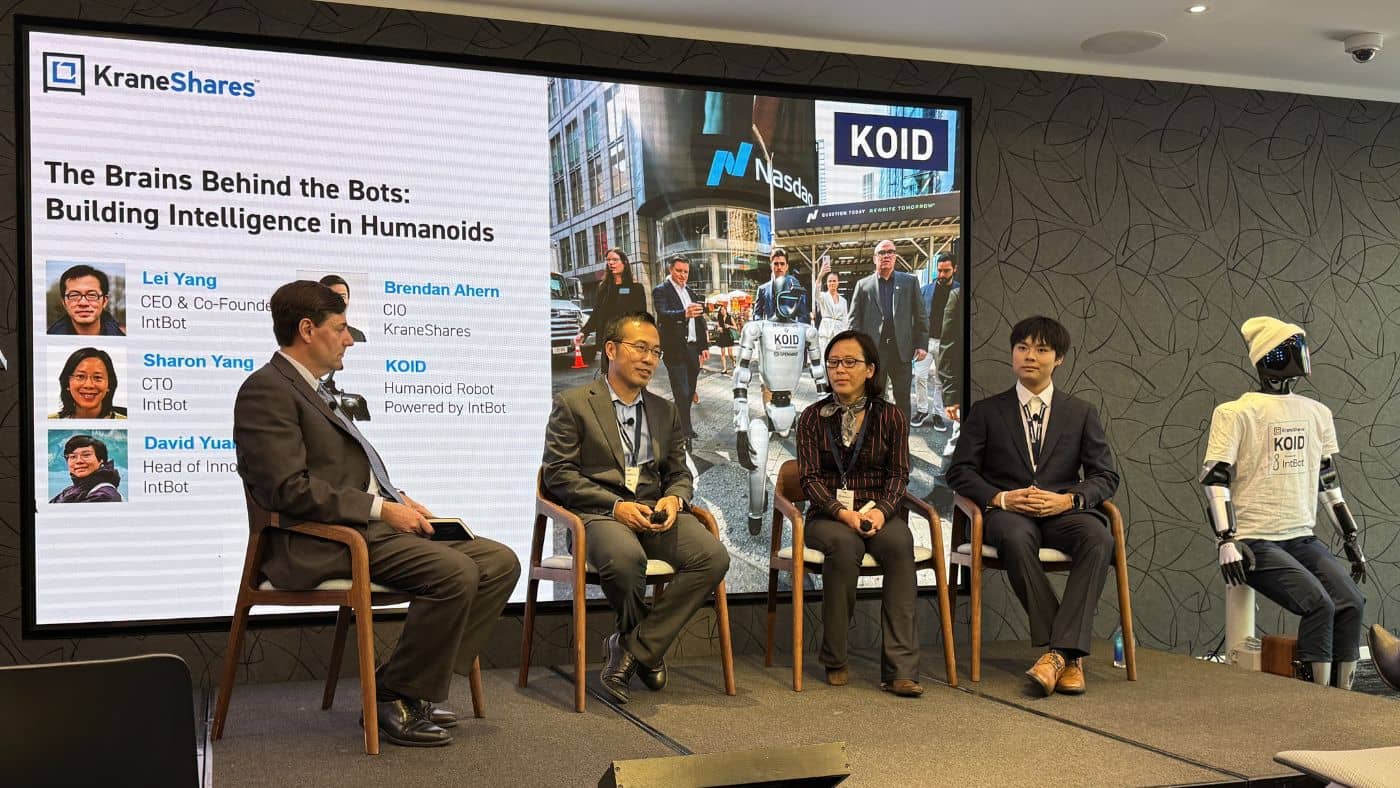
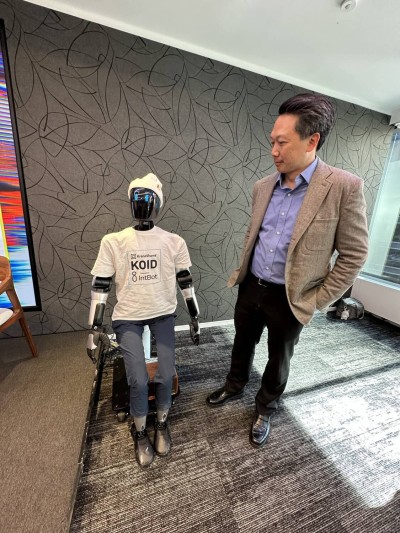
Andy and I had the chance to meet KOID, a humanoid robot that has already been deployed at San Jose airport and a Marriott in Texas. KOID speaks 50 languages, can speak about nearly any topic, and has a sense of humor.
While we are still in the early innings, analysts project that over 1 billion robots will be deployed by 2050. These are exciting, and somewhat surreal, times.
The Thesis: From Digital AI to Physical AI
For the past several years, the world's attention has been riveted on digital artificial intelligence — large language models, generative image tools, and software copilots that live entirely in the cloud. But a parallel revolution is now underway in embodied intelligence: AI systems integrated into physical machines that can sense, learn, and interact with the real world. Humanoid robots sit at the apex of this trend, combining advances in machine learning, computer vision, sensor fusion, and mechanical engineering into platforms designed to work in environments built for people.
The investment case rests on a simple but powerful observation: the physical world is overwhelmingly designed for the human form. Factories, warehouses, hospitals, and homes all feature doors, stairs, tools, and workstations sized for human bodies. A robot that can navigate these environments without costly retrofitting of infrastructure unlocks an addressable market measured in the trillions of dollars of human labor performed globally each year.
Tesla Optimus
Tesla is making the largest single capital commitment to humanoid robotics of any company. In early 2026, CEO Elon Musk announced the discontinuation of Model S and Model X production at the Fremont factory to convert those lines for Optimus manufacturing, part of a $20 billion-plus capital expenditure plan for the year. Tesla is targeting eventual capacity of one million robots per year, though Tesla has a well-documented history of optimistic timelines.The Gen 3 Optimus features hands with 22 degrees of freedom and 50 actuators, and the company is leveraging its Autopilot AI infrastructure to train the robots. However, Musk acknowledged on the Q4 2025 earnings call that the robots deployed internally are primarily for learning and data collection, not yet performing productive work. Low-volume production is expected to begin in summer 2026, with consumer availability targeted for late 2027 at an aspirational price point of $20,000–$30,000.
Unitree Robotics (China)
Unitree has emerged as the volume leader in humanoid shipments. The company shipped over 5,500 humanoid robots in 2025, surpassing the combined output of all U.S. competitors, and is targeting 20,000 units in 2026. Its G1 model is available at a starting price around $16,000, making it one of the most affordable humanoids on the market. Unitree generated approximately 1.71 billion yuan ($235 million) in revenue in 2025, representing 335% year-over-year growth, and filed for an IPO on the Shanghai STAR Market in early 2026. The company's open-sourced AI models are enabling autonomous manipulation across multiple task categories.
Conclusion: Early Innings of a Generational Shift
Humanoid robotics in 2026 feels like the electric vehicle industry a decade ago: the technology is proven and costs are falling, but mass-market dominance is still on the horizon.The convergence of AI capability and global labor shortages creates a powerful structural tailwind. For investors, diversified vehicles such as thematic ETFs can provide exposure across the humanoid robotics value chain, while individual equities like Tesla and NVIDIA offer more concentrated, higher-risk opportunities.For long-term investors, the question is no longer if humanoid robots will transform the global economy, but rather how fast the inflection point will arrive.

Feature image taken by Chris Wang