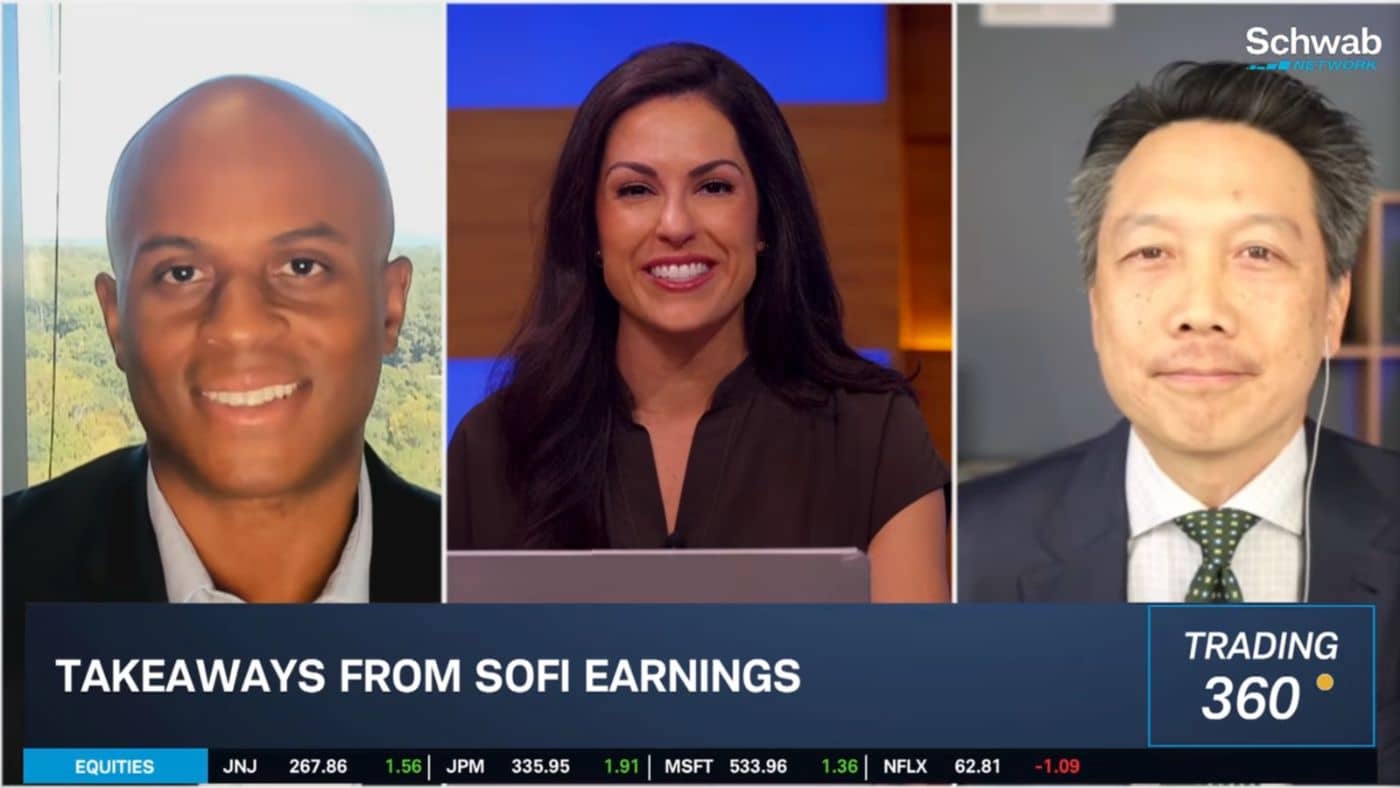
Following a challenging stretch that saw shares fall nearly 45% heading into third-quarter earnings, SoFi Technologies (NASDAQ: SOFI) delivered a performance that challenged prevailing market skepticism. The digital financial services firm reported sharp top- and bottom-line growth, increased full-year guidance, and presented an upbeat outlook extending through 2027.
Runnymede Capital Management’s Andrew Wang joined Marley Kayden on Schwab Network’s Trading 360 to analyze the print, dissect the mechanics behind the rally, and discuss why fundamental investors should maintain a measured approach.
The Numbers Behind the Relief Rally
Heading into the release, market sentiment around SoFi reflected persistent concerns regarding consumer credit risk, valuation multiples, and the durability of its tech-platform premium in an uncertain rate climate.
The headline results provided immediate counterarguments:
- Revenue: Jumped 44% year-over-year.
- Net Income: Surged 73%.
- Guidance: Management raised full-year targets and signaled accelerated earnings expansion through 2027.
- Market Reaction: Shares responded with an immediate rally of approximately 15%.
The quarterly beat confirmed that SoFi’s underlying earnings power continues to expand despite higher interest rates and elevated funding costs across the financial sector.
Lending Drives Record Originations
Lending served as the clear operational engine of the quarter, generating $807 million in revenue. Total loan originations rose 71% to a record $16.9 billion.
Personal unsecured loans accounted for roughly three quarters of that origination volume. While reported credit performance improved during the quarter, rapid expansion in personal lending warrants careful monitoring. Historically, aggressive loan book growth requires several quarters to fully season and reveal ultimate loss rates.
Furthermore, management's forward-looking framework points to revenue growth moderating toward approximately 27% next year, down from roughly 40% in the current fiscal year, as comparative baselines become more demanding.
The Macro Backdrop: The Decisive Factor
As Wang highlighted during the broadcast, the primary test for SoFi’s business model shifts from how quickly originations can scale to how durable that performance remains across changing economic cycles:
“Lower inflation with healthy employment could help borrowers. Lower inflation because the economy is weakening is a different story. For SoFi, the test is whether borrowers keep paying and earnings keep growing as the business matures.”
A soft landing with steady employment supports borrower repayment capacity. Conversely, a macro slowdown driven by labor market deterioration could test newer personal loan vintages across the fintech sector.
The Runnymede Perspective
SoFi’s third-quarter report demonstrated robust operational execution, active member adoption, and commendable expense discipline. However, given demanding comparisons ahead, economic crosscurrents, and the seasoning cycle required for personal credit portfolios, the prudent stance remains a disciplined “watch and see.”
For continued market insights and commentary from the Runnymede team, follow our updates on the Runnymede blog or connect with Andrew Wang on LinkedIn.