JD.com reported better-than-expected second-quarter profits Thursday morning, yet its U.S.-listed shares closed down 7.3% at $29.30. The reaction captures an important theme in Chinese technology today. Some company fundamentals are improving even as China’s broader economy, and particularly its consumer, remains challenged.
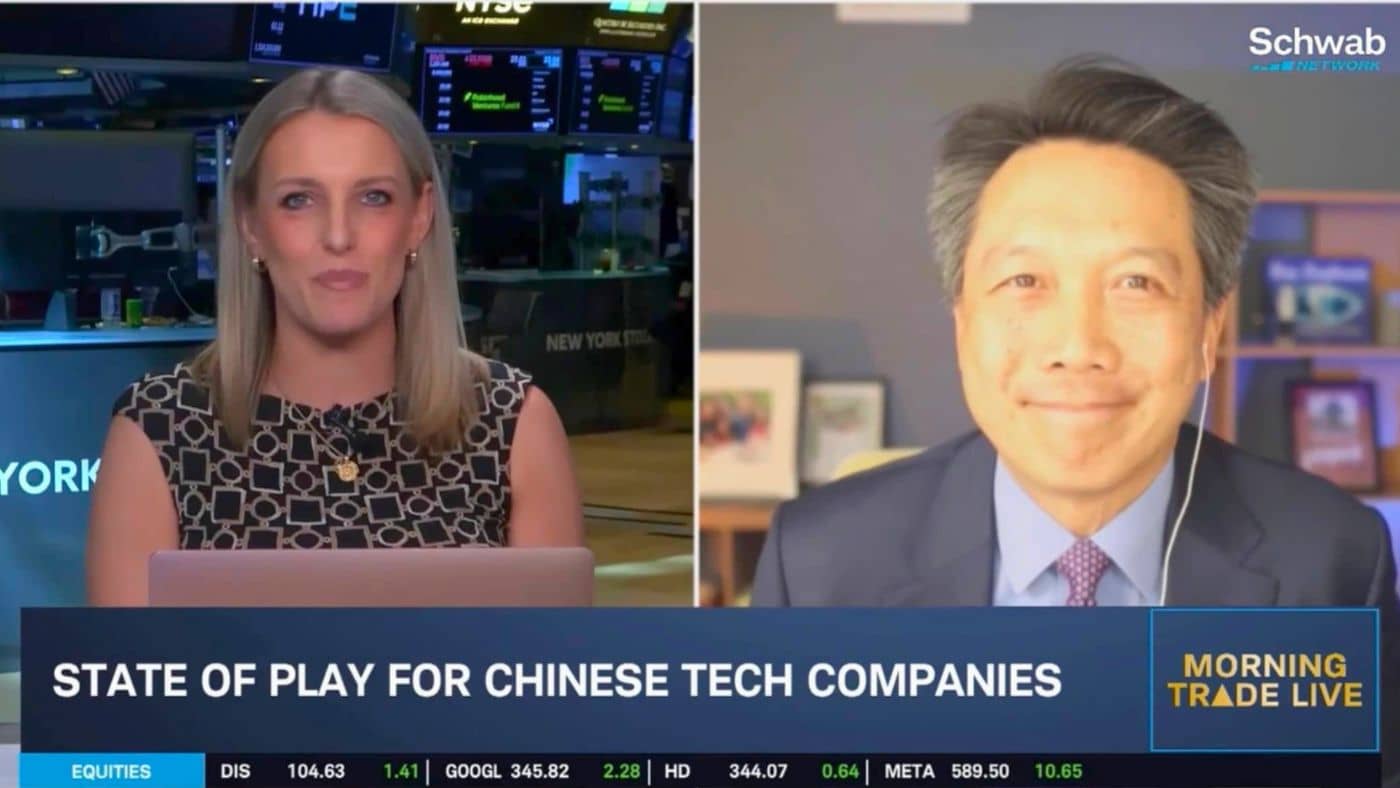
Runnymede Capital Management Managing Partner Andy Wang joined Sam Vadas on Schwab Network’s Morning Trade Live to discuss JD.com’s latest results, what investors should watch when Baidu and Alibaba report next week, and why Runnymede’s broader outlook on China remains cautious but increasingly constructive.
JD.com: Better Execution, Mixed Consumer
JD’s second-quarter results tell two different stories. Revenue declined approximately 3% year over year to RMB 346 billion. Electronics and appliance sales fell 12%, while general merchandise grew 6%, a significant slowdown from 15% growth in the first quarter. Supermarkets, however, remained relatively healthy.
The more encouraging story was profitability. Adjusted net income increased about 21% to RMB 8.9 billion, while free cash flow jumped 45% to roughly RMB 32 billion. JD Retail’s operating margin reached 4.6%. Put simply, JD is becoming more profitable and generating more cash even though its overall sales aren’t growing.
Food delivery also showed improvement. JD, Alibaba and Meituan have been engaged in an expensive battle for market share, with aggressive subsidies weighing on profitability across the industry. JD’s losses in its newer businesses fell roughly 33% from a year earlier, from RMB 14.8 billion to RMB 9.9 billion, as food-delivery unit economics improved. If that competitive environment continues to become more rational, investors may be able to shift some of their attention from subsidies and market share back toward margins, cash flow and sustainable growth.
Still, the results should not be interpreted as evidence that the Chinese consumer has turned the corner. Management expects JD Retail revenue growth to improve in the second half, but some of that improvement should come from easier comparisons in electronics and appliances. JD shares closed down 7.3% following the report, suggesting that better profitability was not enough to overcome investor concerns about top-line growth and the consumer backdrop.
Runnymede’s takeaway: JD is executing better in a still-mixed consumer environment.
Alibaba: AI Growth Is Strong. Now Show the Return.
Alibaba is expected to report its June-quarter results on August 20, and its earnings present a very different question. Cloud has increasingly become central to the Alibaba growth story, with the business growing 38% in the prior quarter and expectations pointing toward another strong quarter as demand for AI-related computing continues to expand.
At the same time, Alibaba is spending aggressively on AI infrastructure, models and applications. That raises the same question investors are increasingly asking about U.S. technology companies: What is the return on all that AI investment? It is no longer enough to demonstrate how much a company is spending on AI or how rapidly usage is growing. Investors increasingly want to understand how much incremental revenue that investment generates, what it does to margins and, ultimately, how much cash flow it can produce.
Strong cloud growth would certainly be encouraging, but the next phase of Alibaba’s AI story is about proving the economics behind that growth. In other words, investors may increasingly judge Alibaba not simply by how quickly its AI businesses expand, but by whether that growth ultimately translates into attractive returns on the capital being invested.
Baidu: AI Is Both the Opportunity and the Disruption
Baidu is expected to report on August 18, and its AI story may be even more complicated. AI Cloud has emerged as an important growth engine, while Baidu’s traditional search advertising business remains under significant pressure. That creates an unusual strategic challenge: AI is helping Baidu build its next business while potentially disrupting its old one.
Baidu built much of its economics around search advertising, but generative AI is changing how consumers find information. That could reduce reliance on traditional search while simultaneously creating new opportunities for Baidu in cloud computing, AI infrastructure and related services. The company therefore has to manage both sides of the technological transition at the same time.
Rapid AI growth by itself is not enough to resolve that tension. Investors should watch AI Cloud growth, the profitability of those newer businesses and the trajectory of traditional advertising together. The central question is whether Baidu’s AI businesses can eventually become large and profitable enough to offset pressure on the legacy search business.
China: Cautious, but Increasingly Constructive
These company-specific developments are occurring against a complicated economic backdrop. China continues to look like a two-speed economy: exports have held up relatively well, while domestic demand remains soft and the property market continues to be a headwind. A broad consumer recovery has yet to emerge.
JD’s results illustrate that disconnect particularly well. Revenue declined, yet profitability and free cash flow improved substantially. Alibaba continues to build its cloud and AI businesses, Baidu is developing new AI businesses while navigating disruption to search, and Tencent is also investing aggressively in artificial intelligence. Company fundamentals can improve even before the broader economy fully recovers.
None of this supports making a blanket bullish call on China. Weak domestic demand, property-market challenges, regulation, geopolitical tensions and other macroeconomic risks remain important considerations. But it does suggest that the investment story is becoming more nuanced, with greater differentiation among individual companies based on profitability, cash generation, competitive positioning and the potential return on AI investment.
That distinction is central to Runnymede’s current view. The outlook on China remains cautious, but increasingly constructive on selected company fundamentals within Chinese technology.
What Investors Should Watch Next
JD, Alibaba and Baidu highlight three different questions facing Chinese technology companies. For JD, the question is whether improving profitability and cash generation can continue if consumer demand remains subdued. For Alibaba, it is whether rapid cloud and AI growth can eventually translate into attractive margins and cash flow. For Baidu, it is whether new AI businesses can grow large and profitable enough to offset disruption to traditional search.
Together, those questions illustrate why treating “China” as a single investment thesis can miss important differences beneath the surface. Macroeconomic conditions will remain important, but company-level execution may increasingly determine which businesses are able to navigate a difficult environment successfully.
JD’s earnings, and the stock’s 7.3% decline that followed, offer a useful reminder that better earnings do not necessarily mean the underlying challenges have disappeared. At the same time, a difficult macroeconomic backdrop does not mean every company’s fundamentals are deteriorating. For investors, distinguishing between the macroeconomic story and company-specific fundamentals may become increasingly important.
Runnymede Capital Management Managing Partner Andy Wang joined Sam Vadas on Schwab Network’s Morning Trade Live on August 13, 2026, to discuss JD.com earnings and the outlook for Alibaba, Baidu and Chinese technology stocks.
This commentary is provided for informational and educational purposes only and should not be construed as individualized investment advice or a recommendation to buy or sell any security. References to individual companies and securities are for discussion purposes only. Past performance is not indicative of future results.