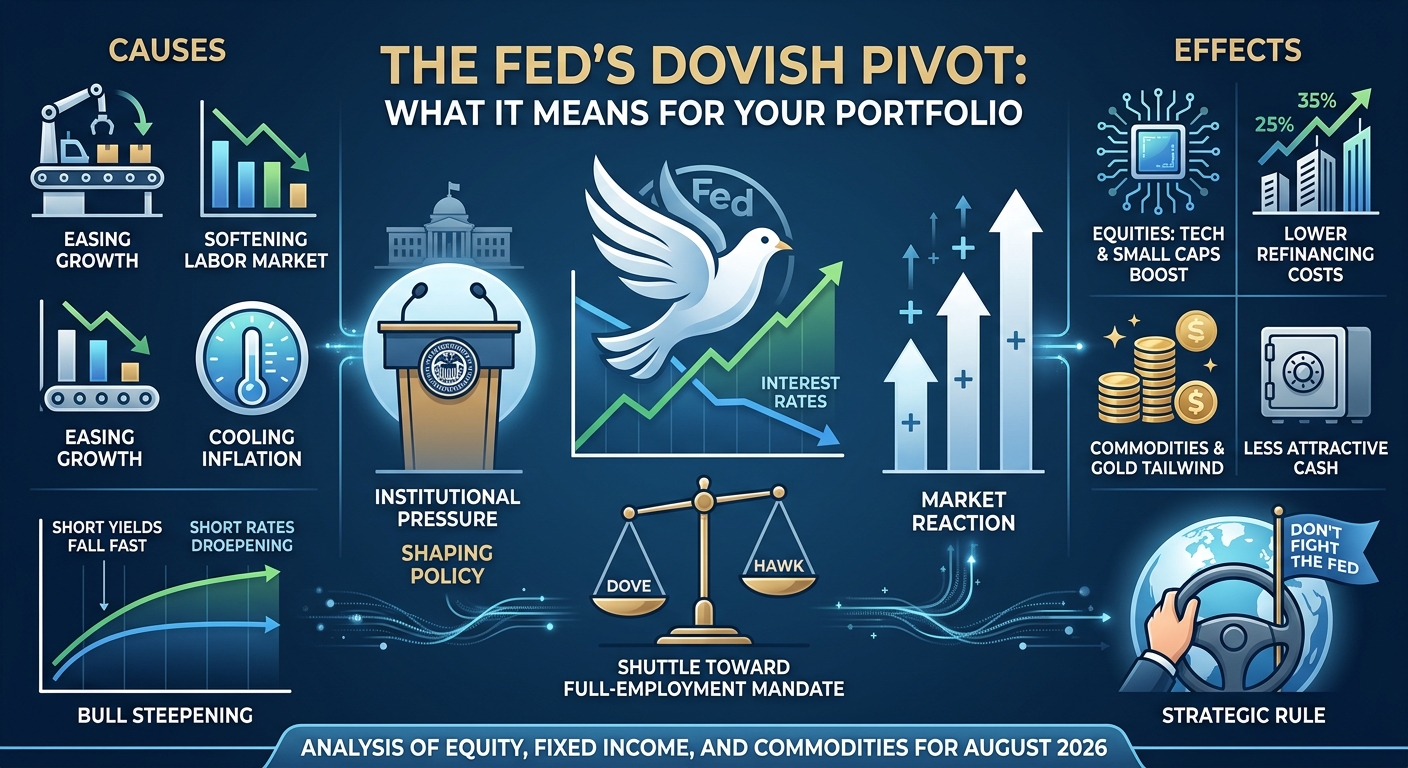
After months of maintaining a “higher-for-longer” stance, the Federal Reserve has noticeably shifted toward a more dovish posture over recent weeks.
While central bankers previously emphasized inflation risks above all else, recent commentary and economic data have forced a recalibration. Softening labor market metrics, cooling core PCE inflation, and easing growth indicators are providing the Fed with the necessary air cover to shift focus toward its full-employment mandate.
Interest rate futures currently price in a near coin-flip for whether the Fed cuts rates or stays put at the upcoming September meeting. Interestingly, futures markets are also floating the possibility of a rate hike in spring 2027. We view a 2027 hike as highly unlikely. Inflation will be lapping the initial price spikes from the start of the Iran conflict; unless the war is actively escalating, year-over-year inflation should cool sharply from March through May 2027—substantially increasing the probability of rate cuts, not hikes.
For investors, a dovish Fed isn't just about lower borrowing costs—it fundamentally alters risk dynamics, yield curve behavior, and asset pricing across global markets.
What’s Driving the Dovish Shift?
Several macro catalysts have converged over the past month to push FOMC members toward a softer tone:
- Cooling Labor Market: Monthly job gains have normalized, wage growth has moderated to non-inflationary levels, and labor market balance has been restored.
- Intact Disinflation Trend: Core inflation metrics continue their downward trajectory toward the Fed’s 2% target, granting policymakers confidence that price stability is within reach.
- Political & Institutional Pressure: With Kevin Warsh nominated as Fed Chair and the administration actively advocating for reduced borrowing costs, institutional sentiment is leaning heavily towards easing. While the Fed maintains formal independence, dovish political signaling adds an undeniable backdrop.
Market Breakdown: Cross-Asset Class Impact
When the Fed flips the script from restrictive to accommodative, financial assets react in distinct ways:
1. Equities: Risk-On Rally Meets Valuation Realities
- Growth & Tech Stocks: Lower discount rates boost the net present value of long-duration growth earnings, giving tech and high-beta sectors a strong tailwind.
- Cyclicals & Small-Caps: Rate-sensitive sectors—such as real estate, regional banks, and small-cap indexes (e.g., Russell 2000)—stand to benefit significantly as debt refinancing costs fall.
- Fixed Income: Yields Drop, Prices Rise
- Short-End Rates: Short-term Treasury yields (such as the 2-Year) fall rapidly as traders price in upcoming policy rate cuts.
- Yield Curve Un-Inversion: A dovish pivot frequently triggers a bull steepening of the yield curve, where short-term yields fall faster than long-term yields as growth expectations stabilize.
The Key Rule: “Don't fight the Fed.” When the central bank signals easing, holding excess cash quickly transforms from a safe haven into a yield-drag penalty.
Feature image from Gemini AI.